...and life as we know it has begun to disintegrate.
Showing posts with label Madrid. Show all posts
Friday, 23 August 2013
Thursday, 22 August 2013
Tuesday, 20 August 2013
Madrid's top tapas
The biggest problem living in Madrid is deciding where to eat next (sigh, woe is me). Madrid's tourist board proudly claims that the city has more bars than any other, and where there are drinks, there are tapas.
But tapas isn't all just plates of jamón and tortilla (delicious though these are). The creativity and innovation of Spain's gastronomic revolution has shaken up the humble tapas bar, and they stand up alongside the best restaurants in Madrid. Here are my five favourites.
1) Le Cabrera
Tapas bar upstairs, cocktail bar downstairs, tiny Le Cabrera is one of my favourite places in the city for a drink, and maybe a plate of seared steak and grilled peaches on the side. The gastro-coctelería is a name-dropping exercise of the famous faces of Spanish cuisine: Sergi Arola, one of the country’s top chefs, devised the creative tapas menu served upstairs (a review of his main restaurant is coming soon), while Diego Cabrera, the Argentinean mixologist, is in charge of the cocktails downstairs.
2) Delic
Delic is nestled in my favourite square in Madrid, Plaza de la Paja in La Latina.
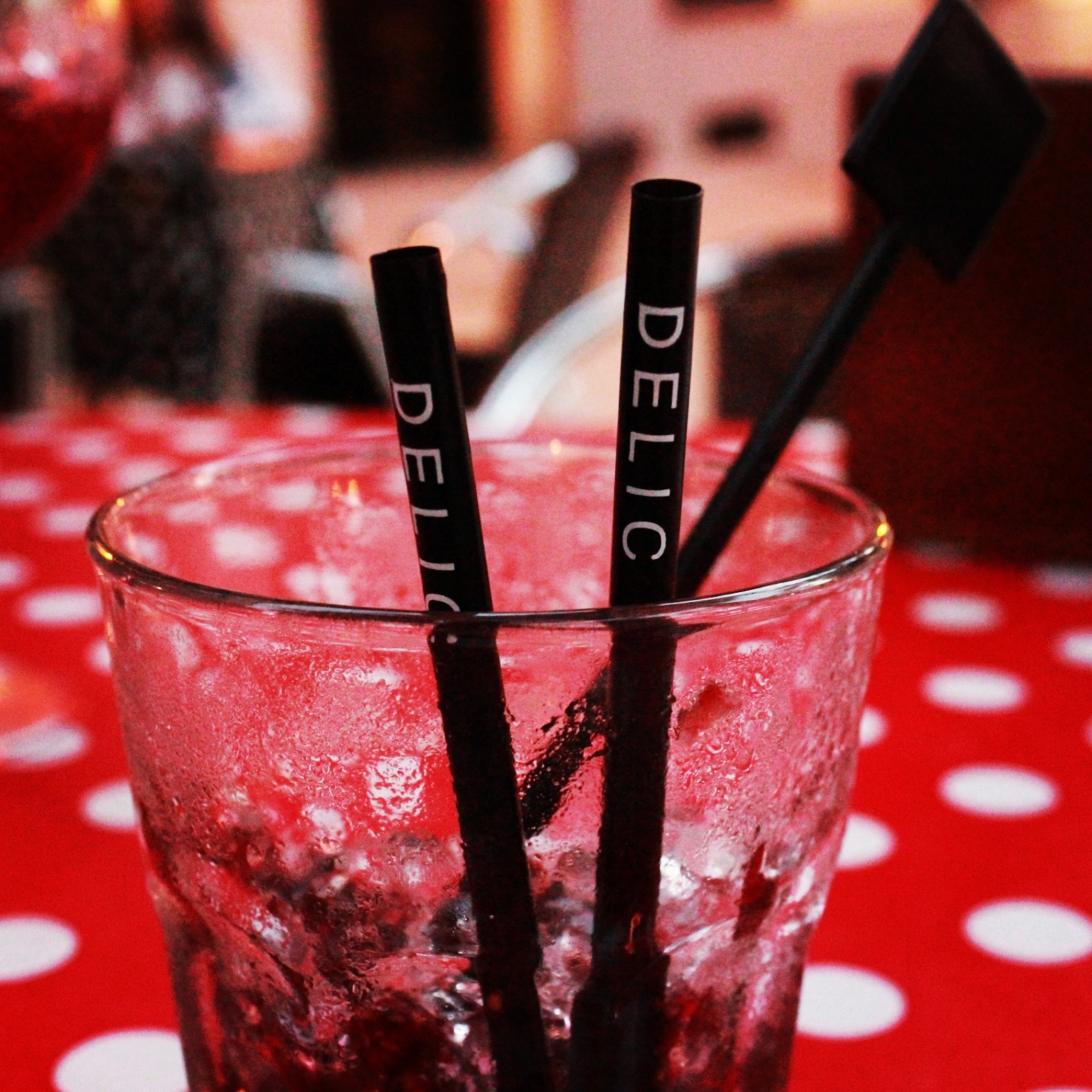
Delic's menu is all about comidas del mundo (food from around the world), which makes a change from the usually patriotic Spanish offerings: Argentine empanadas, Peruvian cerviche and Japanese miso line up alongside the best mojitos in the city.
| The black raspberry caipiroskas aren't bad either. |
3) La Gastromaquia
Hidden down a dark street in Chueca, sandwiched between the sex shops and gay bars, Gastromaquia gets my vote as the best restaurant in Madrid. If you weren't looking for it, you'd walk right past it (you could even walk past it if you were looking for it).
It doesn't look like much from the outside, but each plate is a tiny slice of creative, innovative tapas heaven. Goat's cheese salad (above left) comes dripping in a basil reduction with a caramelised honey roof, and the tikka masala mussels (above right) almost make you want to pick up the bowl to drink the sauce dry.
4) Juana la Loca
At the south end of the Cava Baja in La Latina, where almost every building seems to be a tapas bar, sits Juana la Loca. It's famous for its tortilla de patata (Spanish omelette), but every dish is a winner. Don't miss the restaurant's self-proclaimed "incredible egg", a soft quail's egg nestled on top of a truffle base.
| El increíble huevo ("The Incredible Egg")... |
| Hoisin duck wraps |
| Beef carpaccio |
5) La Musa
With a branch in Malasaña and another next door to Delic in La Latina, it's hard not to drop into La Musa almost every week. My favourite is La Musa Latina for its lazy outdoor terrace in the plaza, although be prepared to queue for a table when the sun's shining.
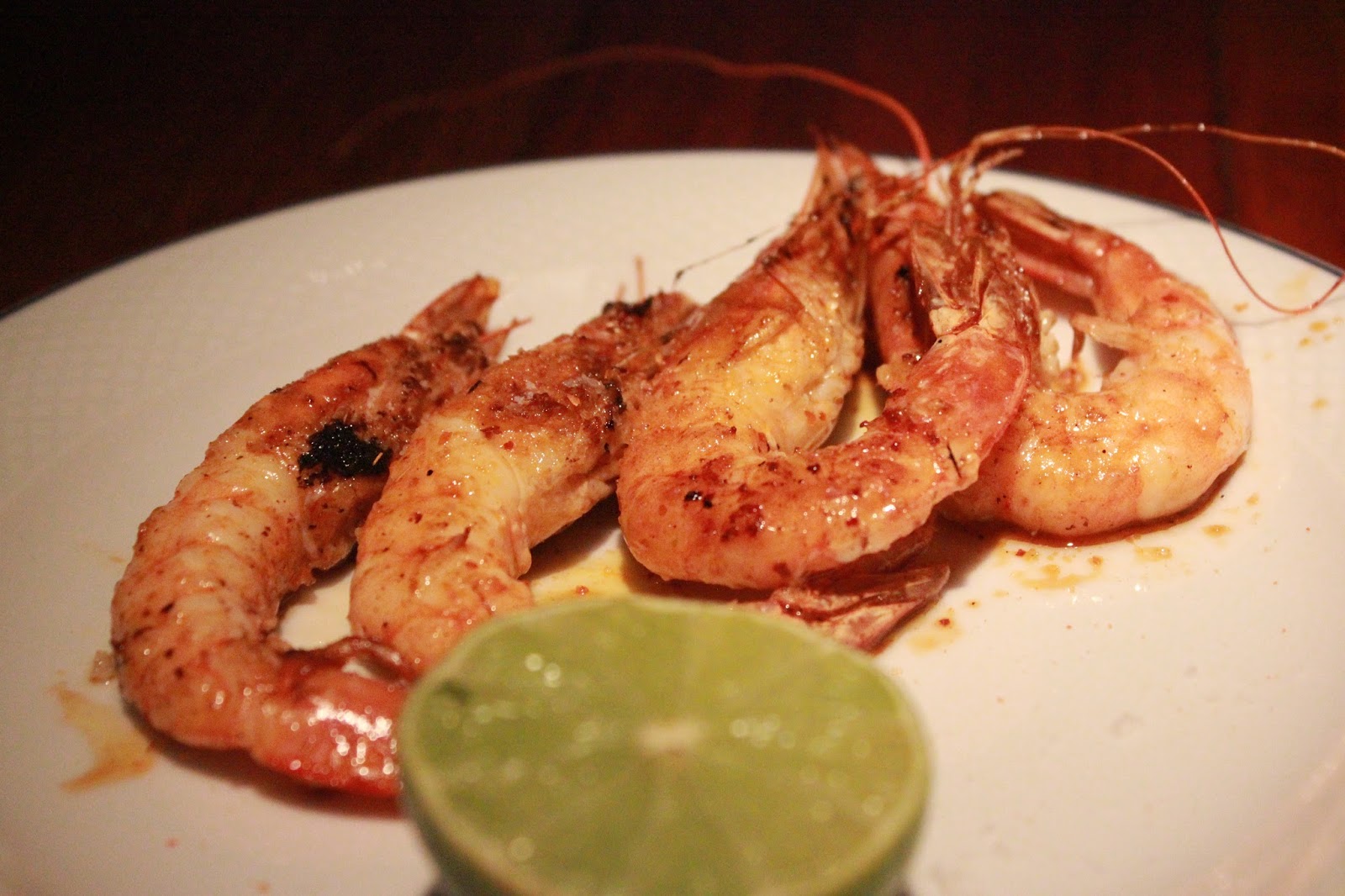
Like Delic, the tapas veer away from traditional Spanish fare, like Japanese dumplings, Caribbean-style barbecued prawns and a pestle and mortar brimming with tomato, avocado and onion, for hungry diners to mash their own guacamole.
So, where next?
Wednesday, 31 July 2013
Il postino
Back to the magnificent Teatro Real, which I last wrote about here, for the final opera of the season.
Daniel Catán's Il Postino is based on the film of the same name, a tribute to Chilean poet Pablo Neruda, one of my favourites. It tells the story of the poet’s spell living on a southern Italian island whilst in exile from Chile in the 1950s, and of his relationship with the villagers. He befriends the young postman and teaches him about love and poetry, all against a backdrop of post-war political uncertainty.
| Projections of Neruda's scribbles of poetry |
The part of Pablo Neruda was written for Plácido Domingo, one of Madrid's most famous sons, who traditionally sings every year in the closing production of the Teatro Real's season. This year Domingo withdrew during rehearsals due to health reasons. The role is associated so strongly with him that the audience nearly revolted, but having never seen the opera before, or even the film, I went along with an open mind.
![]() |
| Vicente Ombuena steps in as Neruda (photo: Javier del Real) |
The staging was absolutely beautiful; covered in blue and white Mediterranean tiles, the stage often became the sea, a focus of Neruda's poetry whilst on the island. As the two main characters discuss or write poetry together, their words are projected onto the constantly changing backdrop, bringing it to life. The libretto is sung in Spanish; it's curiously pleasing to hear snippets of Neruda's poetry faithfully reproduced in his own language.
It had mixed reviews from the Madrid audience, almost entirely due to the lack of their favourite star. But the music was entrancing, it was sung beautifully and the performance was visually stunning: one of the best operas I've been to. Domingo or no Domingo.
Tuesday, 30 July 2013
Wednesday, 17 July 2013
Giacometti: terrenos de juego
Making the most of the two hour lunch break from work, last week I popped in to the Fundación Mapfre's current exhibition on Alberto Giacometti, one of my favourite sculptors. Giacometti: Terrenos de juego ("playing fields" or "game boards") focuses on the artist's interest in the concept of space, culminating in his famous large-scale sculptures for the Chase Manhattan Plaza Project, the Walking Man and Large Woman.
Spread over two floors, the exhibition begins with Giacometti's early surrealist sculptures and drawings, which were often designed to resemble the boards from board games, so that the space around the pieces was as important as the pieces themselves. These developed into plans for enormous public squares, where the observers are physically incorporated into the sculpture itself.
My favourite exhibits in the rooms of his earlier work were the series of black and white photographs taken of Giacometti in his studio by other artists, including Man Ray, Ernst Scheidegger and Henri Cartier-Bresson, which were beautiful pieces of art in their own right.
| The Glade, 1950 |
Spread over two floors, the exhibition begins with Giacometti's early surrealist sculptures and drawings, which were often designed to resemble the boards from board games, so that the space around the pieces was as important as the pieces themselves. These developed into plans for enormous public squares, where the observers are physically incorporated into the sculpture itself.
My favourite exhibits in the rooms of his earlier work were the series of black and white photographs taken of Giacometti in his studio by other artists, including Man Ray, Ernst Scheidegger and Henri Cartier-Bresson, which were beautiful pieces of art in their own right.
The second floor showcases the groupings of stretched, fragile and coarse figures for which he is best known.
| Three Men Walking, 1948 |
The exhibition focuses on the evolution of Giacometti's studio space alongside the drawings and sculptures, which was an interesting touch, even creating a representation of the tiny space by blowing up one of Giacometti's own drawings of his surroundings and wallpapering a room with it.
| Large Woman II, 1960 |
The works gradually lead up to his most famous legacy: exploring how his idol-like nude sculptures of women culminated in the Large Woman, and how his portrait drawings and sculptures of his brother became the Male Head and the Walking Man.
They're free-standing on the gallery floor, allowing you to interact with them and making you notice the spaces between them, just as was originally intended.
| Walking Man I, 1960 |
Until 4 August 2013
Sunday, 14 July 2013
Diego Le Cigala
An unexpected change of plans for a colleague at work, and I was given two last minute tickets to see a flamenco singer I had never heard of. A quick google revealed how ignorant I was; Diego El Cigala is one of the most famous names in flamenco, not just in Spain but worldwide. He's the winner of two Grammy awards and has countless other nominations under his belt.
The concert, part of the Veranos de la Villa (Summer in the City) concert series, was completely sold out and swarming with television cameras. The audience was bristling with anticipation.
The music had so much more depth than I expected, combining elements of flamenco, jazz and tango. His voice is throaty yet smooth, somehow unmistakeably Spanish.
It wasn't long before the audience were on their feet, cheering the opening bars of each song, emotionally applauding the flamenco guitar and trumpet solos and calling for encore after encore. I'm a new flamenco convert.
Saturday, 13 July 2013
Memorias Imaginadas
One of my favourite buildings in Madrid is the Palacio de Cristal, a nineteenth-century iron and glass palace modelled after London's Crystal Palace.
Nestled in Parque del Retiro and adorned with ceramic tiles, it's now used as an exhibition space by the Museo Reina Sofía.
Throughout the summer the Palacio has hosted the Japanese artist Mitsuo Miura's installation Memorias Imaginadas ("Imagined Memories").
Suspended coloured disks hang from the ceiling above partners of the same faded colour.
The effect creates invisible columns of space between the disks suspended from the ceiling and lying on the ground. It augments the feeling of space and, more simply, is just beautiful to look at.
The trees in the park outside and the sunlight streaming through the windows make it feel like the installation is a natural part of the world outside.
The exhibiton's blurb says that the spaces between the disks are intended to come to life with imagination and memory. The use of faded colours is supposed to suggest diffused, faded memories. Whether you buy into that reading or not, it's a beautiful stop off on a stroll through Retiro, and an atmospheric place to catch the sunset.
Until 2 September 2013
Sunday, 30 June 2013
La Corrida de Toros
Few topics lead to more heated discussion than bullfighting. Before I went to a live bullfight, I wasn't really sure what I thought about it. But you have to try something before you can pass judgement.
Madrid's beautiful Las Ventas is the capital of bullfighting, the most prestigious bullring in Spain.
We went twice: first to a traditional corrida de toros or toreo, where the bullfighters are on foot (toreros), and again to a rejoneo, where they're on horseback (rejoneadores).
Bullfighting is all about the ritual - the toreros and rejoneadores parade around the ring before the fight, and each stage is announced with bugle calls.
In a traditional corrida there are six bulls, with three matadores fighting two each. The matadores each lead a cuadrilla (team) of three banderilleros, on foot, two picadores, lancers mounted on horseback, and a sword carrier.
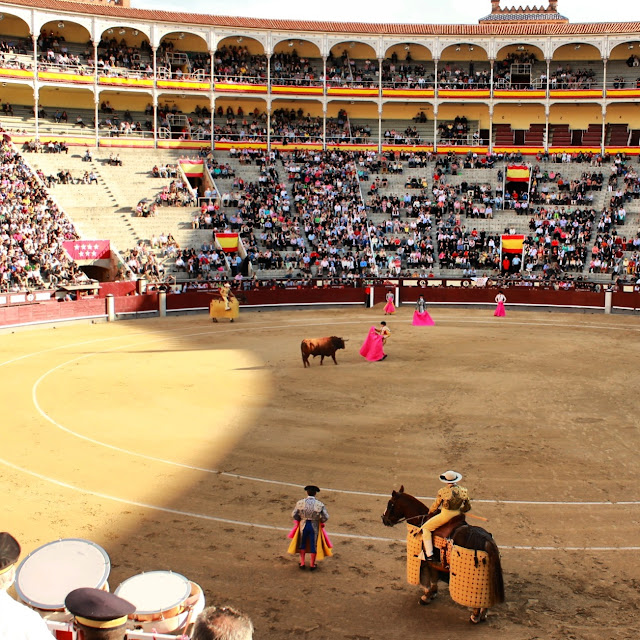
I preferred the rejoneo, where the riders show incredible skill controlling the horse and the bull in a dance of amazing speeds. The show is just as much about the amazing horsemanship as anything else, with the rojoneadores changing horses after every stage, and some horses being almost as famous as their riders.
![]() |
We watched the celebrated Portuguese rejoneador Diego Ventura, one of the world's best, who drew enormous cheers from the crowd. After each of his fights he walked a lap of honour around the ring, and his fans threw down hats, flowers, flasks of wine and even live chickens for him from the stands.
![]() | ![]() |
![]() |
| Diego Ventura |
At the time, it's shocking but impressive, above all at the rejoneo, where the the skill of the riders is unbelievable. The crowds aren't baying for blood, they're applauding bravery, and what they want to see are quick, clean kills, carried out with skill. One rejoneador who struggled to deliver a final, clean blow was met with hostile silence by the crowd.
Although it's a shock and gruesome to watch, the atmosphere is intense. A bit like a car crash; you know it's horrific, but it's hard not to look.
But looking back over my photos now, away from the atmosphere of the day, the blood and cruelty is much more real, and it's an inescapable fact that an animal is being killed for sport alone (although the meat is later eaten).
Away from the live action, when the ritual, symbolism, music and costumes are forgotten, it's hard not to feel some revulsion at the idea. So I'm still undecided.
A quick opinion poll of my Spanish colleagues in the office gives mixed results: most quietly like bullfighting, or can take it or leave it, but it's the atmosphere, the crowd, the ceremony and the tradition that they like, rather than the bullfight itself and the grizzly outcome. One girl my age absolutely adores it; no one at all pipes up to say that they passionately hate it. But the newspapers mourn the fact that numbers at bullfights are increasingly dwindling, and several regions (Catalonia being the most recent) have outlawed it, so it may be on the way out.
If your mind isn't already made up, then definitely go and see for yourself.
Subscribe to:
Posts (Atom)